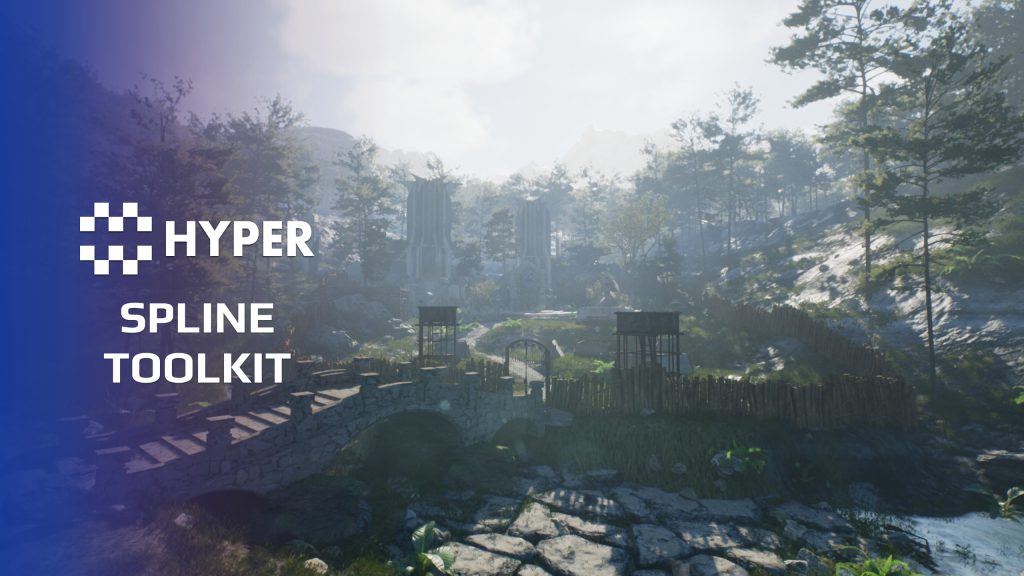
Description
Documentation | Discord | Spline Toolkit | Demo
Hyper Procedural Spline Toolkit v4
Draw the route once, then build the fence, wall or path along it. Hyper Procedural Spline Toolkit combines a mesh-deforming Blueprint workflow with non-deforming PCG placement, giving continuous structures and repeated objects the tools each needs.
Key Features
Continuous mesh structures
- Blueprint spline meshes: bend and orient the selected mesh along a curve for walls, rails and other continuous forms.
- Orientation controls: set the forward axis, spline up direction and inverse rotation.
- Point types: use curve, constant, linear, curve-clamped or custom-tangent points, with a button to apply the chosen type to all points.
- Editor updates: choose automatic spline updates or use Build Spline, and toggle generated collision during authoring.
Repeated objects along a route
- PCG spline placement: place individual meshes without deforming them, useful for fence posts, spikes and repeated boundary pieces.
- Spacing and variation: override section length and configure minimum/maximum scale, rotation and offsets.
- Terrain projection: project the placement to the landscape through the supplied editor action.
Paths and examples
- Spline-based decals: use the decal spawner for road and worn-path presentation.
- Example map: inspect landscape, town fences and small walls to compare the two spline workflows.
Choose mesh deformation for a continuous surface or PCG placement for separate objects, then adapt the example to your own route.
17 reviews for Hyper Procedural Spline Toolkit
You must be logged in to post a review.
Frequently asked questions
Why Hyper?
The strongest public modular Unreal Engine framework available at this scale
Most studios keep tools like this internal. Hyper makes a serious technical foundation available to solo developers, indies, and teams.
Built from 75,000+ hours of Unreal Engine work
System design, Blueprint architecture, multiplayer patterns, documentation, testing, integration, iteration, and real production problem-solving.
Systems designed to work together
Inventory, crafting, equipment, interaction, UI, combat, attributes, multiplayer, AI, quests, dialogue, maps, progression, survival systems, environment tools, performance helpers, and more can all live inside one larger ecosystem.
Working systems with source
Hyper gives you functional systems, a modular structure and documentation, with source you can extend for your own game.
Architecture you can extend
Hyper is built around scalable architecture: gameplay tags, structured data, child Blueprints, clean overrides, reusable components, and clear project boundaries.
Start fast, grow cleanly
Build on the included systems, replace visuals, adjust data, create child Blueprints and connect features without rebuilding the same foundation from scratch.
Want to learn more about the Hyper ecosystem, architecture philosophy, workflows, and developer behind it? Read more here and get started (https://gamesbyhyper.com/docs/getting-started/start-here/).
Can I use this in my own Unreal project?
Yes. Use the supplied example project to try the setup, then follow the product documentation (https://gamesbyhyper.com/docs/environment-building/spline/) for your own project. Use a supported Unreal Engine version and keep the required engine plugins enabled.
Do I need to use the rest of the Hyper ecosystem?
You can use this product in your own project. Other Hyper systems mentioned as optional integrations are separate additions; use the parts that fit your workflow.
Where should I put my own changes?
Keep your own Blueprints, UI and data in your project's folder, for example Content/MyProject. Use child Blueprints or replacement components for your custom logic where possible.
That keeps your changes separate when you update Hyper. If you edit the original framework files directly, you will need to merge those edits when updating. The folder structure guide (https://gamesbyhyper.com/docs/project-foundations/folder-structure/) explains where everything belongs.
What is the difference between the two spline workflows?
The Blueprint spline is useful for meshes that follow the curve, such as continuous walls. The PCG spline places individual meshes along the path without deforming them.
Can spline placement follow the landscape?
Yes. The PCG spline includes a Project to Landscape action to place it against the terrain.
Compatibility and file information
- Development platforms
- Linux, Windows, macOS
- Tested platforms
- Windows
Versions and compatibility
| Version | Release | Unreal Engine |
|---|---|---|
| V3V3 UE5.5, 5.6. Release: V3. | V3 | 5.5, 5.6 |
| V4V4 UE5.7, 5.8. Release: V4. | V4 | 5.7, 5.8 |
Implementation and interaction
- Modular / extensible
- Yes
- Multiplayer ready
- Yes
- UI components
- Yes
- Input methods
- Gamepad, Keyboard, Mouse
- AI gameplay features
- No
System setup
- Implementations: mesh-deforming Blueprint spline and non-deforming PCG mesh placement.
- Controls: point types, section length, axes, rotation, scale, offsets and terrain projection.
- Editor helpers: Build Spline, collision toggles and point-type application.
- Examples: fences, walls and spline-based decal/path content.
Compatibility
- Platform testing: Windows tested.
- Plugins: PCG for procedural generation; Common UI where used by the supplied example.
Release notes | Documentation | YouTube | Discord
Documentation, videos and Discord are public. Verified buyers can use the support forums.
Acquired with code casigus –
Review from FabIf you’ve ever wrestled with Unreal’s spline tool and felt like you were trying to tame a caffeinated snake, this pack is your redemption arc. Hyper’s spline system bends, twists, and behaves like it’s actually read the documentation (unlike most of us).
MrIllDuckYouUp –
Review from FabPretty great addon with tons of potential in your environment-workflow. So far I’ve used it mainly to create spline paths with decals, but also fences etc. Worth it!