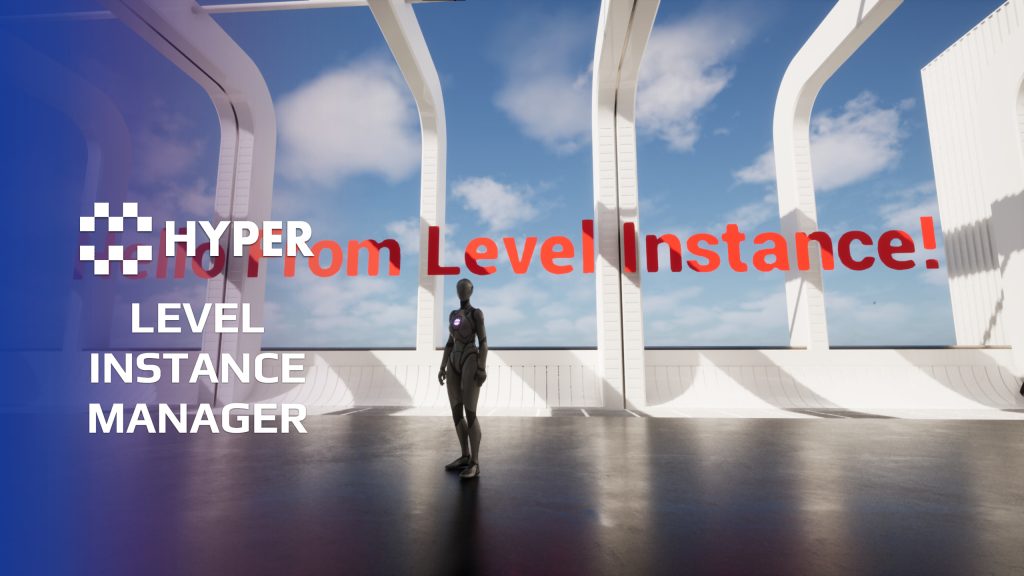
Description
Documentation | Discord | Videos | Demo
Hyper Level Instance Manager v4
Let the world change with the player's progress. Hyper Level Instance Manager loads, unloads and swaps level instances during gameplay, so a quest or world event can replace an intact location with its changed state.
Key Features
Dynamic world sections
- Load and unload: manage modular level instances from one runtime manager.
- World-state swaps: replace one version of a location with another.
- Gameplay triggers: connect changes to overlaps, quest stages or event tags.
- Live tracking: retain loaded-instance references for later unloading.
Multiplayer state
- Recipient filtering: send an update to all players or selected controllers.
- Late-join catch-up: cache required load instructions for players joining later.
- Reusable request data: describe load and unload operations through structured payloads.
Example flow
The supplied demo swaps an intact village for a destroyed version. A trigger builds the request and calls the manager; the manager handles the instance lifecycle and multiplayer distribution.
Use the same approach for a quest location, an unlocked interior or a changed section of your world.
31 reviews for Level Instance Manager
You must be logged in to post a review.
Frequently asked questions
Why Hyper?
The strongest public modular Unreal Engine framework available at this scale
Most studios keep tools like this internal. Hyper makes a serious technical foundation available to solo developers, indies, and teams.
Built from 75,000+ hours of Unreal Engine work
System design, Blueprint architecture, multiplayer patterns, documentation, testing, integration, iteration, and real production problem-solving.
Systems designed to work together
Inventory, crafting, equipment, interaction, UI, combat, attributes, multiplayer, AI, quests, dialogue, maps, progression, survival systems, environment tools, performance helpers, and more can all live inside one larger ecosystem.
Working systems with source
Hyper gives you functional systems, a modular structure and documentation, with source you can extend for your own game.
Architecture you can extend
Hyper is built around scalable architecture: gameplay tags, structured data, child Blueprints, clean overrides, reusable components, and clear project boundaries.
Start fast, grow cleanly
Build on the included systems, replace visuals, adjust data, create child Blueprints and connect features without rebuilding the same foundation from scratch.
Want to learn more about the Hyper ecosystem, architecture philosophy, workflows, and developer behind it? Read more here and get started (https://gamesbyhyper.com/docs/getting-started/start-here/).
How do I add this to my project?
This module is provided as a full project because it includes Gameplay Tags, collision settings, config settings and other project-level dependencies.
Use our free Integration Tool (https://gamesbyhyper.com/product/integration-tool/) to prepare the integration. It combines compatible Hyper projects and handles migration and the required project settings. Use matching Unreal Engine versions and compatible Hyper releases.
Your own character, GameMode or custom systems may still need to be connected. The Integration Tool walkthrough (https://gamesbyhyper.com/docs/getting-started/use-the-automatic-integration-tool/) explains the setup and what to check in the generated project.
Do I need to use other Hyper systems with this?
No. You can use your own systems.
Hyper modules are designed around interfaces, abstract classes, shared contracts and dynamic dispatch, so features are not tied to one specific implementation.
If a module demonstrates integration with our Inventory, Equipment, Interaction, Movement, NPC or another Hyper system, you can:
Use the included Hyper implementation.
Replace it with your own system.
Use our implementation as a reference for your own integration.
The supplied integration shows how the module connects to the rest of a game. You can connect your own implementation through the same interface, abstract class or integration point.
For example, Attribute Manager may demonstrate Equipment modifying attributes. That does not mean you must purchase our Equipment System. You can follow the same integration pattern with your own equipment system.
The module includes working gameplay and its integration points. Build on the supplied setup or connect your own systems where you want different behavior.
See how to adapt a module (https://gamesbyhyper.com/docs/getting-started/customize-modules/) and how the shared data and abstract classes work (https://gamesbyhyper.com/docs/project-foundations/datamanagement/).
Where should I put my own changes?
Keep your own Blueprints, UI and data in your project's folder, for example Content/MyProject. Use child Blueprints or replacement components for your custom logic where possible.
That keeps your changes separate when you update Hyper. If you edit the original framework files directly, you will need to merge those edits when updating. The folder structure guide (https://gamesbyhyper.com/docs/project-foundations/folder-structure/) explains where everything belongs.
Can the world change when a quest reaches a new stage?
Yes. You can load or swap sections of the world as a quest progresses, for example to change an area after an event.
Is this only for quest systems?
No. You can trigger the same flow through collision, tags or other gameplay events.
Compatibility and file information
- Development platforms
- Linux, Windows, macOS
- Tested platforms
- Windows
Versions and compatibility
| Version | Release | Unreal Engine |
|---|---|---|
| V4V4 UE5.7, 5.8. Release: V4. | V4 | 5.7, 5.8 |
Implementation and interaction
- Modular / extensible
- Yes
- Multiplayer ready
- Yes
- UI components
- Yes
- Input methods
- Gamepad, Keyboard, Mouse
- AI gameplay features
- No
System setup
- Component: AC_GS_LevelInstanceManager on the GameState.
- Runtime data: load instructions and references to currently loaded instances.
- Integration: direct calls or registered event-manager listeners.
- Networking: controller filtering and cached load replay for late-joining clients.
Compatibility
- Networking: replicated multiplayer support.
- Platform testing: Windows tested.
- Plugins: Common UI.
Release notes | Documentation | YouTube | Discord
Documentation, videos and Discord are public. Verified buyers can use the support forums.

Dalcon4 –
Review from FabThe Hyper Level Instance System v4 is a powerful world-building tool that enables instanced level streaming with full control over loading, unloading, and state management. It allows developers to create modular, reusable level chunks that can be loaded on demand, making it ideal for dungeons, interiors, procedural world composition, and any scenario requiring dynamic level management. The system covers the full spectrum of level instancing needs. It handles async loading and unloading, instance state persistence, transform offsets, multi-instance support, player tracking across instances, and proper cleanup. The state management system ensures that changes within instances (opened doors, looted chests, defeated enemies) persist correctly across loading cycles. Setting up level instances is intuitive. Define your level chunks as standard sub-levels, configure the instance manager with your loading parameters, and trigger loads through simple Blueprint nodes or volume overlaps. The system handles all the complexity of async streaming, state serialization, and instance transform management behind the scenes. Level streaming is smooth and seamless. Loading transitions can be configured with fade effects or loading screens, and the async system ensures the game thread is never blocked. Instance states load and save reliably, and the system handles edge cases like players being inside an instance that needs to unload gracefully and without crashes. Within MSTPro V4, the Level Instance System works hand-in-hand with the Region Manager to define world zones, the Event Manager to trigger instance loads based on gameplay events, and the Memory System to track player progress within instances. It is the architectural backbone for any large-scale world built with the Hyper V4 framework.