Description
Documentation | Discord | Video | Video | Integration walkthrough (recorded with V3) | Demo
Hyper Quest System v4
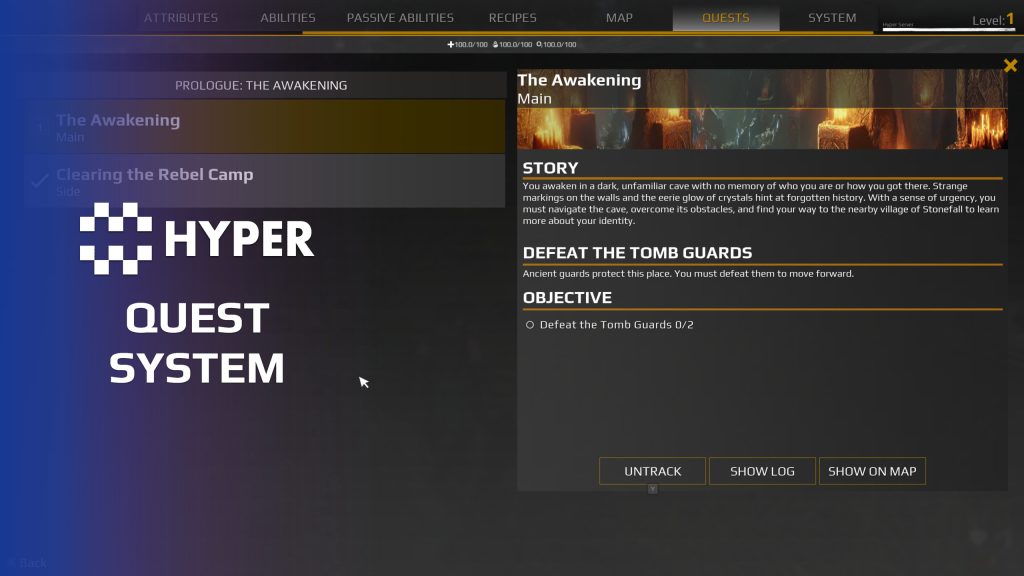
Give players a clear objective and a reason to follow it. Hyper Quest System connects main stories, side quests, staged tasks, rewards and world markers through data-driven quest definitions.
Key Features
Quest structure
- Quest identity: set the name, cover image, description, tag, type and chapter.
- Availability: configure prerequisites and recommended levels.
- Abandon rules: mark quests that should remain in the log.
- Multiple stages: give each stage its own active/completed log, objectives and rewards.
- Optional objectives: add secondary goals alongside the required tasks.
Objective types
- Items and resources: deliver, obtain, gather, craft, steal, use or consume items.
- Characters and encounters: kill targets, find NPCs or interact with actors.
- Knowledge and progression: learn skills, reach a level or complete narrative pieces.
- World actions: discover areas, perform configured gameplay actions or use a skill.
Progression and presentation
- Quest log: browse and track quests with their description and image.
- Live feedback: show objective and stage progress as events occur.
- Markers: display objectives together or reveal them in sequence.
- World triggers: start or advance a quest from interaction, dialogue, overlap or custom logic.
- Stage rewards: grant configured items, XP, currency or remembered outcomes.
- Narrative stages: use a narrative Blueprint when a stage needs its own scripted flow.
Authoring and supporting systems
Quest rows live in DT_Quests and are assigned through the GameState tag mapper. The player quest manager connects them to the log, tracking and marker presentation. Dialogue and event triggers let a conversation or world action move the quest forward.
Author a quest players can follow
- Stable Gameplay Tag identities: quests, targets, sources and markers use tags, keeping an objective tied to its gameplay meaning rather than only its display text.
- Counts and optional goals: set the amount required for a task and decide which objectives are optional. A stage can track several distinct activities together.
- Control what the player sees next: reveal objective markers in order or together, limit markers to active quests and hide completed ones through the status settings.
- Broader action tracking: ability use, item consumption, area discovery and narrative completion sit alongside combat, gathering, crafting and delivery objectives.
- Extend the task and reward vocabulary: add a task or reward type with its matching handling logic when your game introduces a mechanic beyond the existing set.
Follow the walkthrough above to create a small quest, then extend it with stages and rewards.
56 reviews for Quest System
You must be logged in to post a review.
Frequently asked questions
Why Hyper?
The strongest public modular Unreal Engine framework available at this scale
Most studios keep tools like this internal. Hyper makes a serious technical foundation available to solo developers, indies, and teams.
Built from 75,000+ hours of Unreal Engine work
System design, Blueprint architecture, multiplayer patterns, documentation, testing, integration, iteration, and real production problem-solving.
Systems designed to work together
Inventory, crafting, equipment, interaction, UI, combat, attributes, multiplayer, AI, quests, dialogue, maps, progression, survival systems, environment tools, performance helpers, and more can all live inside one larger ecosystem.
Working systems with source
Hyper gives you functional systems, a modular structure and documentation, with source you can extend for your own game.
Architecture you can extend
Hyper is built around scalable architecture: gameplay tags, structured data, child Blueprints, clean overrides, reusable components, and clear project boundaries.
Start fast, grow cleanly
Build on the included systems, replace visuals, adjust data, create child Blueprints and connect features without rebuilding the same foundation from scratch.
Want to learn more about the Hyper ecosystem, architecture philosophy, workflows, and developer behind it? Read more here and get started (https://gamesbyhyper.com/docs/getting-started/start-here/).
How do I add this to my project?
This module is provided as a full project because it includes Gameplay Tags, collision settings, config settings and other project-level dependencies.
Use our free Integration Tool (https://gamesbyhyper.com/product/integration-tool/) to prepare the integration. It combines compatible Hyper projects and handles migration and the required project settings. Use matching Unreal Engine versions and compatible Hyper releases.
Your own character, GameMode or custom systems may still need to be connected. The Integration Tool walkthrough (https://gamesbyhyper.com/docs/getting-started/use-the-automatic-integration-tool/) explains the setup and what to check in the generated project.
Do I need to use other Hyper systems with this?
No. You can use your own systems.
Hyper modules are designed around interfaces, abstract classes, shared contracts and dynamic dispatch, so features are not tied to one specific implementation.
If a module demonstrates integration with our Inventory, Equipment, Interaction, Movement, NPC or another Hyper system, you can:
Use the included Hyper implementation.
Replace it with your own system.
Use our implementation as a reference for your own integration.
The supplied integration shows how the module connects to the rest of a game. You can connect your own implementation through the same interface, abstract class or integration point.
For example, Attribute Manager may demonstrate Equipment modifying attributes. That does not mean you must purchase our Equipment System. You can follow the same integration pattern with your own equipment system.
The module includes working gameplay and its integration points. Build on the supplied setup or connect your own systems where you want different behavior.
See how to adapt a module (https://gamesbyhyper.com/docs/getting-started/customize-modules/) and how the shared data and abstract classes work (https://gamesbyhyper.com/docs/project-foundations/datamanagement/).
Where should I put my own changes?
Keep your own Blueprints, UI and data in your project's folder, for example Content/MyProject. Use child Blueprints or replacement components for your custom logic where possible.
That keeps your changes separate when you update Hyper. If you edit the original framework files directly, you will need to merge those edits when updating. The folder structure guide (https://gamesbyhyper.com/docs/project-foundations/folder-structure/) explains where everything belongs.
Can quests have multiple stages and different objective types?
Yes. A quest can have multiple stages and objectives, such as gathering, crafting, interacting, defeating a target or discovering an area.
Can quests require earlier progress or grant rewards?
Yes. Use requirements such as levels, skills or earlier quests, and grant rewards such as items, XP or currency.
Compatibility and file information
- Development platforms
- Linux, Windows, macOS
- Tested platforms
- Windows
Versions and compatibility
| Version | Release | Unreal Engine |
|---|---|---|
| V3V3 UE5.5, 5.6. Release: V3. | V3 | 5.5, 5.6 |
| V4V4 UE5.7, 5.8. Release: V4. | V4 | 5.7, 5.8 |
Implementation and interaction
- Modular / extensible
- Yes
- Multiplayer ready
- Yes
- UI components
- Yes
- Input methods
- Gamepad, Keyboard, Mouse
- AI gameplay features
- No
System setup
- Data: DT_Quests with quest information and ordered stage/objective/reward structures.
- Registration: Linked Quest Table on the GameState tag mapper.
- Runtime: player quest manager with event-triggered progression and UI/marker updates.
- Extension: objective types, narrative stage Blueprints and reward/event integrations.
Compatibility
- Networking: replicated multiplayer support.
- Platform testing: Windows tested.
- Plugins: Common UI.
Release notes | Documentation | YouTube | Discord
Documentation, videos and Discord are public. Verified buyers can use the support forums.
theblondebondOO –
Review from FabAs a mission designer myself this system is excellent and is very similar to what is used in AAA companies so is not only great fro indie devs but also gives new designers a feel of what a well crafted system runs and feels like
Acquired with code t_ibox –
Review from FabHyper Quest System v4 is an outstanding asset that brings a strong structure to quest creation and management in Unreal Engine projects. It is a complete system designed to create richer gameplay experiences and better player progression. What I appreciate the most is the flexibility of the system. It allows developers to create different types of objectives, organize quest steps, and add more depth to player interactions within the game world. This opens many possibilities for adventure games, survival games, RPGs, and open-world projects. The system is clean and well designed, making it much easier to create content without having to build an entire quest framework from scratch. It saves development time while keeping a solid and scalable foundation. The overall quality matches the other Hyper tools: professional design, great attention to detail, and a structure clearly made for real production projects. This is a great addition for developers who want to create a more alive world with objectives, progression, and deeper player immersion. Excellent work, highly recommended!
Xx-JayCook-xX –
Review from FabThis is genuinely a great system, I created about 5 quests (All personalised) just by changing a few data tables for my vertical slice. Just having the quest system meant that I had actual objectives. Instead of just running around the map playing with the features I’ve made/ bought. It actually gave a sense of purpose, it comes with a huge list of different quest types and it’s really simple to add your own.
NotTheFed –
Review from FabI have a LOT of Hyper’s kits.. and for a lot it is plug in play for the basics. I have MST PRO as the base framework, and just plug in those that are relevant for my game like Dialog, companion, advanced NPC, lockpicking, Skills, quests, traps, unlock (learn), world map, weathertime, Skinning, body decompose, Mesh to Actor swap, Admin console, with chat.. and so on. Simple to understand, and gets you started with most key parts of any game framework I highly recommend, not just for the quality of the kit.. but the excellent support on discord. The very detailed documentation.
JDLTorre –
Review from FabThis is an awesome system and easy to integrate with the Dialogue system it gives allot of life to any survival or rpg system.
xSgtSalty –
Review from FabEasy to add in, very flexible system. Saved me alot of time and work.