Description
Documentation | Discord | Videos | Demo
Hyper Databank & Codex System v4
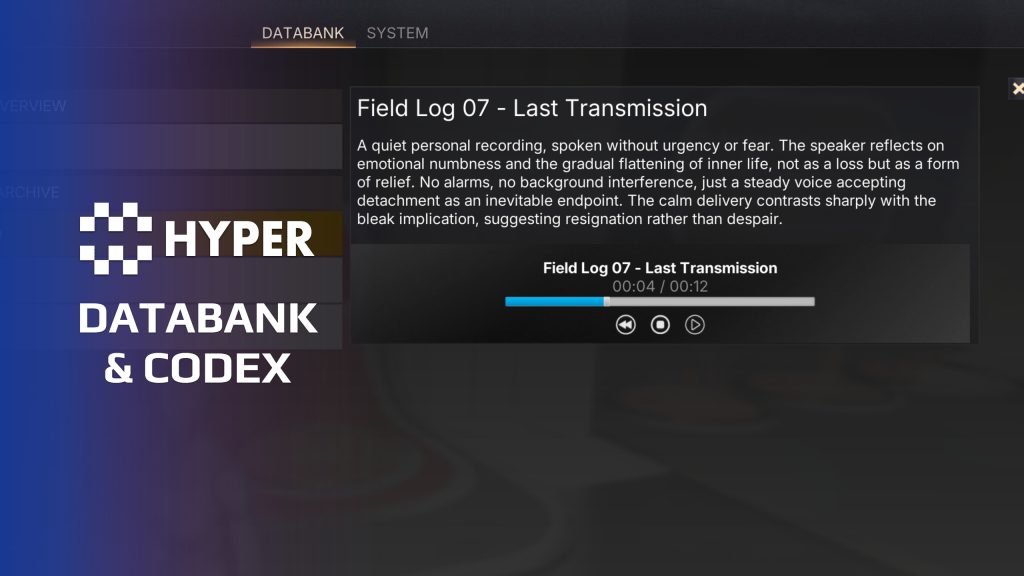
Give players one place to revisit what they have learned. Hyper Databank & Codex System organizes tutorials, lore, creature records, item details and discoveries in a categorized knowledge interface.
Key Features
Content and organization
- Mixed content: combine text, images, video, audio, hyperlinks and dividers in one entry.
- Ordered sections: build a short note or a longer page from stacked content blocks.
- Categories: use category tags to create chapters and subcategories.
- Entry presentation: configure button text, icons and optional widget overrides.
Discovery and authoring
- Unlockable entries: add knowledge when a gameplay event or discovery occurs.
- Starting knowledge: choose which entries are available when the player begins.
- DataTable authoring: manage reusable entries centrally through DT_Databank.
- Runtime entries: inject an entry from structured data when the content is contextual or generated by your own systems.
- Discovery feedback: mark a newly unlocked entry for selection when the menu opens, and use the entry-added event to refresh the UI or show a discovery prompt.
- Duplicate prevention: the manager tracks known entries before adding another copy.
Supporting interface and integrations
The player-owned manager connects discovered knowledge to the category list and information panel. Guide and Inspection integrations let a tutorial or inspected object reveal an entry. The content-block approach does not require a Rich Text toolbar.
Use the demo to explore the entry types, then build your own codex categories in the table.
35 reviews for Databank & Codex System
You must be logged in to post a review.
Frequently asked questions
Why Hyper?
The strongest public modular Unreal Engine framework available at this scale
Most studios keep tools like this internal. Hyper makes a serious technical foundation available to solo developers, indies, and teams.
Built from 75,000+ hours of Unreal Engine work
System design, Blueprint architecture, multiplayer patterns, documentation, testing, integration, iteration, and real production problem-solving.
Systems designed to work together
Inventory, crafting, equipment, interaction, UI, combat, attributes, multiplayer, AI, quests, dialogue, maps, progression, survival systems, environment tools, performance helpers, and more can all live inside one larger ecosystem.
Working systems with source
Hyper gives you functional systems, a modular structure and documentation, with source you can extend for your own game.
Architecture you can extend
Hyper is built around scalable architecture: gameplay tags, structured data, child Blueprints, clean overrides, reusable components, and clear project boundaries.
Start fast, grow cleanly
Build on the included systems, replace visuals, adjust data, create child Blueprints and connect features without rebuilding the same foundation from scratch.
Want to learn more about the Hyper ecosystem, architecture philosophy, workflows, and developer behind it? Read more here and get started (https://gamesbyhyper.com/docs/getting-started/start-here/).
How do I add this to my project?
This module is provided as a full project because it includes Gameplay Tags, collision settings, config settings and other project-level dependencies.
Use our free Integration Tool (https://gamesbyhyper.com/product/integration-tool/) to prepare the integration. It combines compatible Hyper projects and handles migration and the required project settings. Use matching Unreal Engine versions and compatible Hyper releases.
Your own character, GameMode or custom systems may still need to be connected. The Integration Tool walkthrough (https://gamesbyhyper.com/docs/getting-started/use-the-automatic-integration-tool/) explains the setup and what to check in the generated project.
Do I need to use other Hyper systems with this?
No. You can use your own systems.
Hyper modules are designed around interfaces, abstract classes, shared contracts and dynamic dispatch, so features are not tied to one specific implementation.
If a module demonstrates integration with our Inventory, Equipment, Interaction, Movement, NPC or another Hyper system, you can:
Use the included Hyper implementation.
Replace it with your own system.
Use our implementation as a reference for your own integration.
The supplied integration shows how the module connects to the rest of a game. You can connect your own implementation through the same interface, abstract class or integration point.
For example, Attribute Manager may demonstrate Equipment modifying attributes. That does not mean you must purchase our Equipment System. You can follow the same integration pattern with your own equipment system.
The module includes working gameplay and its integration points. Build on the supplied setup or connect your own systems where you want different behavior.
See how to adapt a module (https://gamesbyhyper.com/docs/getting-started/customize-modules/) and how the shared data and abstract classes work (https://gamesbyhyper.com/docs/project-foundations/datamanagement/).
Where should I put my own changes?
Keep your own Blueprints, UI and data in your project's folder, for example Content/MyProject. Use child Blueprints or replacement components for your custom logic where possible.
That keeps your changes separate when you update Hyper. If you edit the original framework files directly, you will need to merge those edits when updating. The folder structure guide (https://gamesbyhyper.com/docs/project-foundations/folder-structure/) explains where everything belongs.
Can entries contain more than text?
Yes. Entries can contain images, video, audio and links as well as text. Organize them into categories and unlock them through gameplay events.
Why might a video stop working after migration?
The Media Source may still point to the original file, or the video itself may be missing. Copy the video into your project's Content/Movies folder, update the Media Source path and test it in the Media Player.
Compatibility and file information
- Development platforms
- Linux, Windows, macOS
- Tested platforms
- Windows
Versions and compatibility
| Version | Release | Unreal Engine |
|---|---|---|
| V4V4 UE5.7, 5.8. Release: V4. | V4 | 5.7, 5.8 |
Implementation and interaction
- Modular / extensible
- Yes
- Multiplayer ready
- Yes
- UI components
- Yes
- Input methods
- Gamepad, Keyboard, Mouse
- AI gameplay features
- No
System setup
- Architecture: PlayerController databank manager with category/entry selection and information widgets.
- Data model: Gameplay Tag identifiers, DT_Databank and structured runtime entry instances.
- Presentation: ordered content sections with per-entry button and information-widget overrides.
- Integration: tag-based unlock calls or direct structured-entry injection.
Compatibility
- Networking: replicated multiplayer support.
- Platform testing: Windows tested.
- Plugins: Common UI.
Release notes | Documentation | YouTube | Discord
Documentation, videos and Discord are public. Verified buyers can use the support forums.

Dalcon4 –
Review from FabThe Hyper Databank & Codex System v4 is a centralized knowledge hub that serves as your game’s encyclopedia, tutorial center, and lore repository all in one. It supports rich media content including videos, audio clips, external links, and formatted text entries, enabling developers to create immersive information systems for tutorials, creature dossiers, item databases, and narrative lore.