Description
Documentation | Discord | Videos | Demo
Hyper Guild & Clan System v4
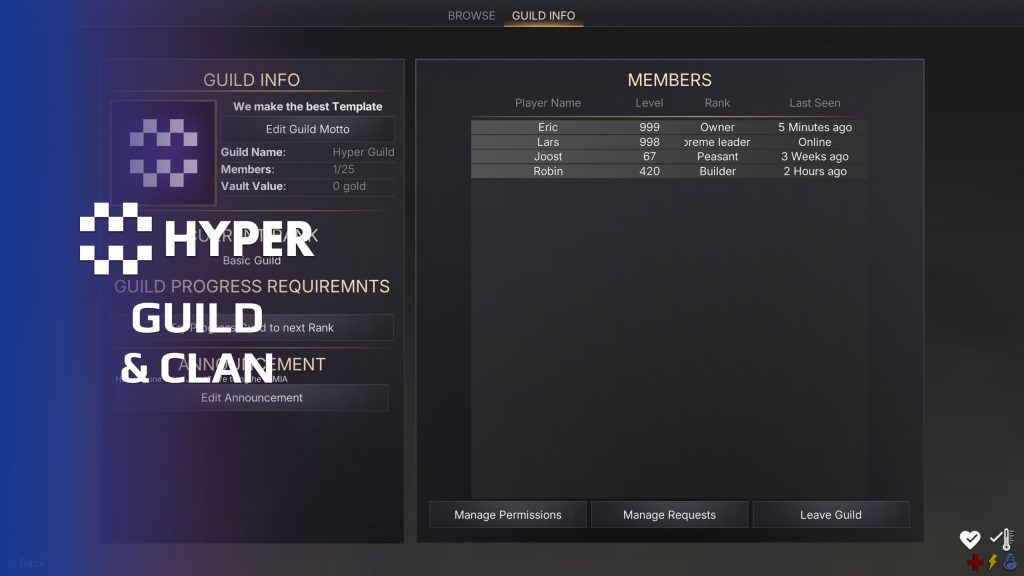
Give players an organization they can build together. Hyper Guild & Clan System connects guild creation, membership, permissions, shared storage and rank progression to the existing team framework.
Key Features
Membership and management
- Guild browser: find groups and access the creation and joining flow.
- Public and private guilds: allow direct joining or review applications containing a motivation message, player level and submission time.
- Ownership and roles: manage ownership and member permissions.
- Guild identity: configure the name, branding, information and announcement.
- Member records: track contribution and last-seen information.
Shared resources and progression
- Guild inventory: provide a shared container for each guild.
- Linked guild chests: let the same world chest open each player's own guild container, keeping shared supplies separated by guild.
- Rank progression: use requirements, completion events and perks to define stages.
- Permission-gated interactions: restrict doors, chests or management actions to the appropriate guild members.
- Replicated state: keep authoritative guild data on the GameState for connected players.
Supporting interface and integration
The PlayerController handles guild menus and requests, while the GameState owns membership and shared inventory. PlayerState team extensions apply member-level checks. The demo includes browsing, creation, private requests, linked storage and a guild-restricted door.
Use those systems to build the organization rules that fit your game.
33 reviews for Guild & Clan System
You must be logged in to post a review.
Frequently asked questions
Why Hyper?
The strongest public modular Unreal Engine framework available at this scale
Most studios keep tools like this internal. Hyper makes a serious technical foundation available to solo developers, indies, and teams.
Built from 75,000+ hours of Unreal Engine work
System design, Blueprint architecture, multiplayer patterns, documentation, testing, integration, iteration, and real production problem-solving.
Systems designed to work together
Inventory, crafting, equipment, interaction, UI, combat, attributes, multiplayer, AI, quests, dialogue, maps, progression, survival systems, environment tools, performance helpers, and more can all live inside one larger ecosystem.
Working systems with source
Hyper gives you functional systems, a modular structure and documentation, with source you can extend for your own game.
Architecture you can extend
Hyper is built around scalable architecture: gameplay tags, structured data, child Blueprints, clean overrides, reusable components, and clear project boundaries.
Start fast, grow cleanly
Build on the included systems, replace visuals, adjust data, create child Blueprints and connect features without rebuilding the same foundation from scratch.
Want to learn more about the Hyper ecosystem, architecture philosophy, workflows, and developer behind it? Read more here and get started (https://gamesbyhyper.com/docs/getting-started/start-here/).
How do I add this to my project?
This module is provided as a full project because it includes Gameplay Tags, collision settings, config settings and other project-level dependencies.
Use our free Integration Tool (https://gamesbyhyper.com/product/integration-tool/) to prepare the integration. It combines compatible Hyper projects and handles migration and the required project settings. Use matching Unreal Engine versions and compatible Hyper releases.
Your own character, GameMode or custom systems may still need to be connected. The Integration Tool walkthrough (https://gamesbyhyper.com/docs/getting-started/use-the-automatic-integration-tool/) explains the setup and what to check in the generated project.
Do I need to use other Hyper systems with this?
No. You can use your own systems.
Hyper modules are designed around interfaces, abstract classes, shared contracts and dynamic dispatch, so features are not tied to one specific implementation.
If a module demonstrates integration with our Inventory, Equipment, Interaction, Movement, NPC or another Hyper system, you can:
Use the included Hyper implementation.
Replace it with your own system.
Use our implementation as a reference for your own integration.
The supplied integration shows how the module connects to the rest of a game. You can connect your own implementation through the same interface, abstract class or integration point.
For example, Attribute Manager may demonstrate Equipment modifying attributes. That does not mean you must purchase our Equipment System. You can follow the same integration pattern with your own equipment system.
The module includes working gameplay and its integration points. Build on the supplied setup or connect your own systems where you want different behavior.
See how to adapt a module (https://gamesbyhyper.com/docs/getting-started/customize-modules/) and how the shared data and abstract classes work (https://gamesbyhyper.com/docs/project-foundations/datamanagement/).
Where should I put my own changes?
Keep your own Blueprints, UI and data in your project's folder, for example Content/MyProject. Use child Blueprints or replacement components for your custom logic where possible.
That keeps your changes separate when you update Hyper. If you edit the original framework files directly, you will need to merge those edits when updating. The folder structure guide (https://gamesbyhyper.com/docs/project-foundations/folder-structure/) explains where everything belongs.
Can guilds have ranks and shared storage?
Yes. Guilds have ranks and permissions, shared storage, progression and announcements.
Is this a service that hosts my game's guild data?
It provides the guild gameplay inside your Unreal project. Any external account service, database or server hosting needs its own setup.
Compatibility and file information
- Development platforms
- Linux, Windows, macOS
- Tested platforms
- Windows
Versions and compatibility
| Version | Release | Unreal Engine |
|---|---|---|
| V4V4 UE5.7, 5.8. Release: V4. | V4 | 5.7, 5.8 |
Implementation and interaction
- Modular / extensible
- Yes
- Multiplayer ready
- Yes
- UI components
- Yes
- Input methods
- Gamepad, Keyboard, Mouse
- AI gameplay features
- No
System setup
- Architecture: GameState guild and guild-inventory managers, PlayerController guild UI/request component and PlayerState team extension.
- Storage: one linked inventory container per guild, exposed through guild-aware interaction actors.
- Progression: rank requirements, events and perks.
- Permissions: membership/role checks for management requests and restricted world interactions.
Compatibility
- Networking: replicated multiplayer support.
- Platform testing: Windows tested.
- Plugins: Common UI.
Release notes | Documentation | YouTube | Discord
Documentation, videos and Discord are public. Verified buyers can use the support forums.
Acquired with code t_ibox –
Review from FabAn excellent guild and clan system, very complete and well designed. This asset provides many useful features to create a real community experience in a game, including member management, clan organization, progression systems, and customization tools. The system structure is clear and shows a lot of quality work. The integration is well made and helps developers save a lot of time instead of having to build all these features from scratch. This is a solid, professional asset that is perfect for projects looking to add an advanced guild or clan system. Great work from the creator, highly recommended!
Dalcon4 –
Review from FabThe Hyper Guild Manager v4 is a full-featured social organization system that enables players to create, manage, and participate in guilds, clans, or any group structure. It handles the complete guild lifecycle including creation, invitations, ranks, permissions, member management, and dissolution, all with proper multiplayer replication. Every guild management feature is accounted for. Guild creation with custom names and emblems, hierarchical rank systems, rank-based permissions, member invitations and applications, officer promotion and demotion, guild messaging, shared resources, and alliance management between guilds. The system even handles edge cases like the guild leader going offline or the last member leaving. Setting up the Guild Manager is straightforward. The system comes with pre-built UI widgets for guild creation, management, and member lists. All guild operations are exposed as simple Blueprint functions, and the data model is configured through data tables. Integrating guild functionality into your existing menus and social systems requires minimal effort. The guild system is responsive and reliable. Member list updates propagate quickly, rank changes take effect immediately, and the invitation system handles accept/decline flows cleanly. The UI is polished and professional, with clear visual hierarchy for ranks and permissions. The system scales well to support guilds of any size without performance degradation. The Guild Manager integrates tightly with the MSTPro V4 social layer. It uses the Affiliation System for guild-vs-guild allegiances, the Permission System for rank-based access control, the Region Manager for guild territory claims, and the Reputation System for guild-wide standing. It is the organizational backbone for any community-focused multiplayer game built on Hyper V4.