Description
Documentation | Discord | Videos | Demo
Hyper Security & CCTV System v4
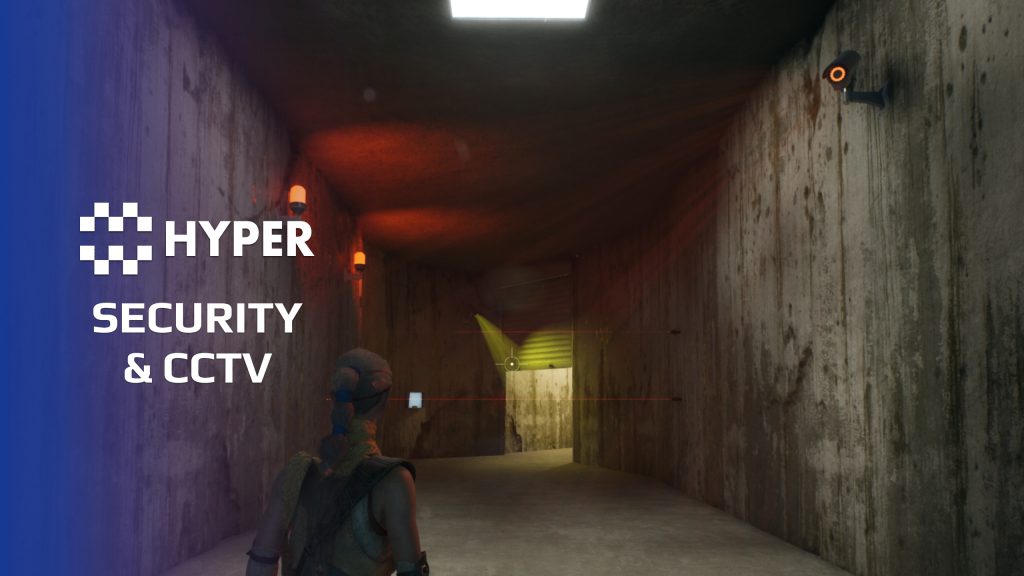
Build a security network that responds as a connected system. Hyper Security & CCTV links cameras, lasers, detectors, doors, alarms and terminals, so one detection can change the state of an entire area.
Key Features
Detection and connections
- Security cameras: combine overlap detection, line-of-sight checks, patrol rotation and target locking.
- Laser tripwires and detectors: trigger the configured response when a valid target is detected.
- Connected listeners: link detectors to doors, lamps, sirens or other security actors.
- Authorized occupants: use actor identity and affiliation with the security manager's Gameplay Tag to distinguish allowed players or NPCs from alarm targets.
- Area management: use the optional security manager to coordinate a room or group of modules.
- Shared states: configure Armed, Searching, Alarm and Disarmed behavior.
Surveillance and feedback
- CCTV terminals: view and control available cameras through the terminal interface.
- Camera feeds: use scene-capture Render Targets for the visual feed.
- Alarms and lights: communicate the current security state through sound and visual changes.
- State presentation: configure materials, particles and other feedback per state.
- Multiplayer requests: use the camera ownership and client/server request flow for player control.
Example setups
The demo connects cameras, lasers, buttons, doors and lamps through a shared detection interface. Start with a direct detector-to-listener link, then use the manager or terminal when several actors need coordinated control.
Use those building blocks for a stealth encounter, restricted facility or player-base alarm network.
Build a security encounter with clear rules
- Directional connections: choose which detectors notify which listeners. Connecting one camera to another does not automatically create a reverse connection.
- Sight that respects cover: camera visibility traces check that the target is unobstructed, with configurable range and time before a lost target is released.
- Patrol and tracking behavior: configure scanning angles, rotation and target locking, then give Searching and Alarm their own sounds, lighting and materials.
- View-only or controlled cameras: offer camera feeds with different control permissions. The terminal manages camera switching and returns ownership when the player exits.
- Broken and disabled devices: broken cameras enter the disarmed state, and the terminal selection flow skips unusable cameras.
- Room-wide control: a manager and control panel can arm, disarm or trigger a connected group, while alarm timing controls the return toward a neutral state.
32 reviews for Security System
You must be logged in to post a review.
Frequently asked questions
Why Hyper?
The strongest public modular Unreal Engine framework available at this scale
Most studios keep tools like this internal. Hyper makes a serious technical foundation available to solo developers, indies, and teams.
Built from 75,000+ hours of Unreal Engine work
System design, Blueprint architecture, multiplayer patterns, documentation, testing, integration, iteration, and real production problem-solving.
Systems designed to work together
Inventory, crafting, equipment, interaction, UI, combat, attributes, multiplayer, AI, quests, dialogue, maps, progression, survival systems, environment tools, performance helpers, and more can all live inside one larger ecosystem.
Working systems with source
Hyper gives you functional systems, a modular structure and documentation, with source you can extend for your own game.
Architecture you can extend
Hyper is built around scalable architecture: gameplay tags, structured data, child Blueprints, clean overrides, reusable components, and clear project boundaries.
Start fast, grow cleanly
Build on the included systems, replace visuals, adjust data, create child Blueprints and connect features without rebuilding the same foundation from scratch.
Want to learn more about the Hyper ecosystem, architecture philosophy, workflows, and developer behind it? Read more here and get started (https://gamesbyhyper.com/docs/getting-started/start-here/).
How do I add this to my project?
This module is provided as a full project because it includes Gameplay Tags, collision settings, config settings and other project-level dependencies.
Use our free Integration Tool (https://gamesbyhyper.com/product/integration-tool/) to prepare the integration. It combines compatible Hyper projects and handles migration and the required project settings. Use matching Unreal Engine versions and compatible Hyper releases.
Your own character, GameMode or custom systems may still need to be connected. The Integration Tool walkthrough (https://gamesbyhyper.com/docs/getting-started/use-the-automatic-integration-tool/) explains the setup and what to check in the generated project.
Do I need to use other Hyper systems with this?
No. You can use your own systems.
Hyper modules are designed around interfaces, abstract classes, shared contracts and dynamic dispatch, so features are not tied to one specific implementation.
If a module demonstrates integration with our Inventory, Equipment, Interaction, Movement, NPC or another Hyper system, you can:
Use the included Hyper implementation.
Replace it with your own system.
Use our implementation as a reference for your own integration.
The supplied integration shows how the module connects to the rest of a game. You can connect your own implementation through the same interface, abstract class or integration point.
For example, Attribute Manager may demonstrate Equipment modifying attributes. That does not mean you must purchase our Equipment System. You can follow the same integration pattern with your own equipment system.
The module includes working gameplay and its integration points. Build on the supplied setup or connect your own systems where you want different behavior.
See how to adapt a module (https://gamesbyhyper.com/docs/getting-started/customize-modules/) and how the shared data and abstract classes work (https://gamesbyhyper.com/docs/project-foundations/datamanagement/).
Where should I put my own changes?
Keep your own Blueprints, UI and data in your project's folder, for example Content/MyProject. Use child Blueprints or replacement components for your custom logic where possible.
That keeps your changes separate when you update Hyper. If you edit the original framework files directly, you will need to merge those edits when updating. The folder structure guide (https://gamesbyhyper.com/docs/project-foundations/folder-structure/) explains where everything belongs.
Can cameras display their view on an in-game monitor?
Yes. You can show a CCTV camera feed on an in-game monitor and connect detection to alarms.
Can sensors trigger other defenses?
Yes. Use the detection events from cameras, motion sensors or tripwires to trigger your own defenses or lockdown logic.
Compatibility and file information
- Development platforms
- Linux, Windows, macOS
- Tested platforms
- Windows
Versions and compatibility
| Version | Release | Unreal Engine |
|---|---|---|
| V4V4 UE5.7, 5.8. Release: V4. | V4 | 5.7, 5.8 |
Implementation and interaction
- Modular / extensible
- Yes
- Multiplayer ready
- Yes
- UI components
- Yes
- Input methods
- Gamepad, Keyboard, Mouse
- AI gameplay features
- No
System setup
- Model: shared E_Security_State and state-data structures.
- Connections: interface-aware actor arrays or BP_SecurityManager coordination.
- Cameras: detection, line-of-sight, patrol, target locking and terminal control.
- Multiplayer: replicated states with camera ownership, UI/input setup and request wrappers.
Compatibility
- Networking: replicated multiplayer support.
- Platform testing: Windows tested.
- Plugins: Common UI.
Release notes | Documentation | YouTube | Discord
Documentation, videos and Discord are public. Verified buyers can use the support forums.


Dalcon4 –
Review from FabThe Hyper Security System v4 allows you to place fully functional CCTV cameras, laser tripwires, motion detectors, and alarm sirens throughout your game world. It is a complete surveillance and security framework that adds stealth gameplay, base defense mechanics, and environmental hazards with full multiplayer replication. The module is incredibly thorough. It includes four distinct security device types, each with configurable detection parameters, visual indicators, alert states, and response behaviors. CCTV cameras feature patrol patterns and view cones, tripwires detect line crossings, motion detectors use configurable radius checks, and alarms propagate alerts through connected networks. The alert system supports cascading activations and timed resets.