Description
Documentation | Discord | Video | Video | Demo
Hyper Visual Novel System v4
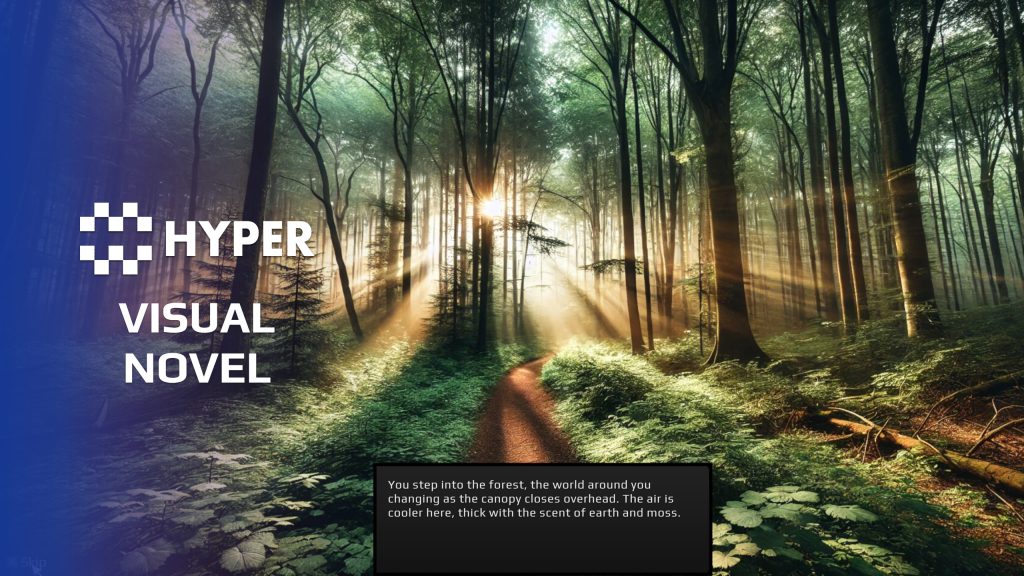
Tell a story through illustrated scenes, dialogue, music and recorded lines. Hyper Visual Novel System lets you author ordered narrative sequences in data assets and play them from an interaction, quest or world trigger.
Key Features
Scene authoring
- Background images: give each scene its own visual setting.
- Music and ambience: change the soundscape or carry the previous track into the next scene.
- Dialogue and narration: organize spoken text into ordered sentences.
- Optional voice and animation: assign an audio clip and character montage to a sentence.
- Memory context: associate a line with remembered narrative or gameplay context.
Playback
- Player-paced scenes: wait for input before moving on.
- Automatic sequences: advance through the timeline with configured scene timing.
- Gameplay entry points: start a story moment from an overlap, NPC interaction, quest completion or custom event.
- Reusable definitions: duplicate an existing data asset and replace its scenes and sentences.
Where it fits
Use the system for chapter openings, flashbacks, mission transitions, character introductions or narrated endings. The player component handles sequence playback while data assets hold the content, so new scenes follow the same structure.
Create a short sequence in the editor and connect its start call to your chosen gameplay event.
40 reviews for Visual Novel System
You must be logged in to post a review.
Frequently asked questions
Why Hyper?
The strongest public modular Unreal Engine framework available at this scale
Most studios keep tools like this internal. Hyper makes a serious technical foundation available to solo developers, indies, and teams.
Built from 75,000+ hours of Unreal Engine work
System design, Blueprint architecture, multiplayer patterns, documentation, testing, integration, iteration, and real production problem-solving.
Systems designed to work together
Inventory, crafting, equipment, interaction, UI, combat, attributes, multiplayer, AI, quests, dialogue, maps, progression, survival systems, environment tools, performance helpers, and more can all live inside one larger ecosystem.
Working systems with source
Hyper gives you functional systems, a modular structure and documentation, with source you can extend for your own game.
Architecture you can extend
Hyper is built around scalable architecture: gameplay tags, structured data, child Blueprints, clean overrides, reusable components, and clear project boundaries.
Start fast, grow cleanly
Build on the included systems, replace visuals, adjust data, create child Blueprints and connect features without rebuilding the same foundation from scratch.
Want to learn more about the Hyper ecosystem, architecture philosophy, workflows, and developer behind it? Read more here and get started (https://gamesbyhyper.com/docs/getting-started/start-here/).
How do I add this to my project?
This module is provided as a full project because it includes Gameplay Tags, collision settings, config settings and other project-level dependencies.
Use our free Integration Tool (https://gamesbyhyper.com/product/integration-tool/) to prepare the integration. It combines compatible Hyper projects and handles migration and the required project settings. Use matching Unreal Engine versions and compatible Hyper releases.
Your own character, GameMode or custom systems may still need to be connected. The Integration Tool walkthrough (https://gamesbyhyper.com/docs/getting-started/use-the-automatic-integration-tool/) explains the setup and what to check in the generated project.
Do I need to use other Hyper systems with this?
No. You can use your own systems.
Hyper modules are designed around interfaces, abstract classes, shared contracts and dynamic dispatch, so features are not tied to one specific implementation.
If a module demonstrates integration with our Inventory, Equipment, Interaction, Movement, NPC or another Hyper system, you can:
Use the included Hyper implementation.
Replace it with your own system.
Use our implementation as a reference for your own integration.
The supplied integration shows how the module connects to the rest of a game. You can connect your own implementation through the same interface, abstract class or integration point.
For example, Attribute Manager may demonstrate Equipment modifying attributes. That does not mean you must purchase our Equipment System. You can follow the same integration pattern with your own equipment system.
The module includes working gameplay and its integration points. Build on the supplied setup or connect your own systems where you want different behavior.
See how to adapt a module (https://gamesbyhyper.com/docs/getting-started/customize-modules/) and how the shared data and abstract classes work (https://gamesbyhyper.com/docs/project-foundations/datamanagement/).
Where should I put my own changes?
Keep your own Blueprints, UI and data in your project's folder, for example Content/MyProject. Use child Blueprints or replacement components for your custom logic where possible.
That keeps your changes separate when you update Hyper. If you edit the original framework files directly, you will need to merge those edits when updating. The folder structure guide (https://gamesbyhyper.com/docs/project-foundations/folder-structure/) explains where everything belongs.
Is this a full visual-novel authoring suite?
It is a basic system for presenting visual-novel scenes and sequential dialogue. Try the demo to see whether the supplied workflow fits what you want to build.
Can dialogue advance automatically or wait for input?
Both are supported. Let the player advance the dialogue or use timed progression, with configurable backgrounds and audio.
Compatibility and file information
- Development platforms
- Linux, Windows, macOS
- Tested platforms
- Windows
Versions and compatibility
| Version | Release | Unreal Engine |
|---|---|---|
| V3V3 UE5.5, 5.6. Release: V3. | V3 | 5.5, 5.6 |
| V4V4 UE5.7, 5.8. Release: V4. | V4 | 5.7, 5.8 |
Implementation and interaction
- Modular / extensible
- Yes
- Multiplayer ready
- Yes
- UI components
- Yes
- Input methods
- Gamepad, Keyboard, Mouse
- AI gameplay features
- No
System setup
- Runtime: AC_PC_VisualNovelSystem on the PlayerController.
- Content: DA_VisualNovel with an ordered timeline of scenes and sentences.
- Media: Texture2D backgrounds, Sound Base audio and optional animation montages.
- Progression: manual input or automatic scene timing; optional memory context per sentence.
Compatibility
- Platform testing: Windows tested.
- Plugins: Common UI.
Release notes | Documentation | YouTube | Discord
Documentation, videos and Discord are public. Verified buyers can use the support forums.
Xx-JayCook-xX –
Review from FabThere’s really not too much to say on this system which is actually a really good thing. I personally used it to create an opening scene for my game that tells a story. Since making it they’ve actually updated the system to allow for videos and other media instead of just pictures and audio. So I will be going back and redoing it – Very excited about that. I recommend anything Hyper related as the support is great and the systems are very high quality. If you want to create a good atmospheric introduction then I strongly recommend this – you can also trigger it within the game too, so really good for transitions or cut scenes