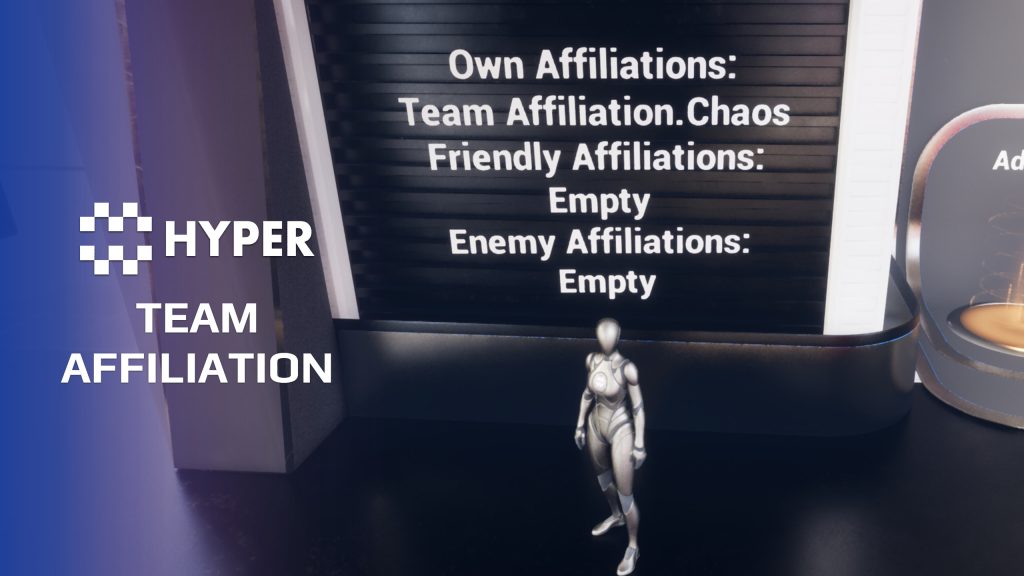
Description
Documentation | Discord | Videos | Demo
Hyper Team Affiliation System v4
Let actors recognize who they belong with. Hyper Team Affiliation uses shared Gameplay Tags to represent teams, factions and guilds, giving combat, AI and world interactions a common way to check relationships.
Key Features
Affiliation model
- Multiple memberships: assign more than one team, faction or group tag to an actor.
- Shared-tag checks: determine affiliation by comparing the relevant tag sets.
- Dynamic membership: change tags when a player changes team or a world event changes allegiance.
- More than characters: use affiliation on actors such as doors, vendors and other controlled objects.
Gameplay integration
- Combat rules: use affiliation queries when deciding whether damage or targeting is allowed.
- AI relationships: supply team context to perception and response logic.
- Access checks: combine membership with your interaction or permission rules.
- Owner choice: keep persistent player affiliation on a controller or life-specific membership on a character.
A shared relationship check
The component supplies affiliation data and queries. Your combat, AI or access system decides what a match means for that action. This keeps team identity reusable across several gameplay systems.
Define the groups your game needs, then connect those checks to the rules that should respect them.
32 reviews for Team Affiliation System
You must be logged in to post a review.
Frequently asked questions
Why Hyper?
The strongest public modular Unreal Engine framework available at this scale
Most studios keep tools like this internal. Hyper makes a serious technical foundation available to solo developers, indies, and teams.
Built from 75,000+ hours of Unreal Engine work
System design, Blueprint architecture, multiplayer patterns, documentation, testing, integration, iteration, and real production problem-solving.
Systems designed to work together
Inventory, crafting, equipment, interaction, UI, combat, attributes, multiplayer, AI, quests, dialogue, maps, progression, survival systems, environment tools, performance helpers, and more can all live inside one larger ecosystem.
Working systems with source
Hyper gives you functional systems, a modular structure and documentation, with source you can extend for your own game.
Architecture you can extend
Hyper is built around scalable architecture: gameplay tags, structured data, child Blueprints, clean overrides, reusable components, and clear project boundaries.
Start fast, grow cleanly
Build on the included systems, replace visuals, adjust data, create child Blueprints and connect features without rebuilding the same foundation from scratch.
Want to learn more about the Hyper ecosystem, architecture philosophy, workflows, and developer behind it? Read more here and get started (https://gamesbyhyper.com/docs/getting-started/start-here/).
How do I add this to my project?
This module is provided as a full project because it includes Gameplay Tags, collision settings, config settings and other project-level dependencies.
Use our free Integration Tool (https://gamesbyhyper.com/product/integration-tool/) to prepare the integration. It combines compatible Hyper projects and handles migration and the required project settings. Use matching Unreal Engine versions and compatible Hyper releases.
Your own character, GameMode or custom systems may still need to be connected. The Integration Tool walkthrough (https://gamesbyhyper.com/docs/getting-started/use-the-automatic-integration-tool/) explains the setup and what to check in the generated project.
Do I need to use other Hyper systems with this?
No. You can use your own systems.
Hyper modules are designed around interfaces, abstract classes, shared contracts and dynamic dispatch, so features are not tied to one specific implementation.
If a module demonstrates integration with our Inventory, Equipment, Interaction, Movement, NPC or another Hyper system, you can:
Use the included Hyper implementation.
Replace it with your own system.
Use our implementation as a reference for your own integration.
The supplied integration shows how the module connects to the rest of a game. You can connect your own implementation through the same interface, abstract class or integration point.
For example, Attribute Manager may demonstrate Equipment modifying attributes. That does not mean you must purchase our Equipment System. You can follow the same integration pattern with your own equipment system.
The module includes working gameplay and its integration points. Build on the supplied setup or connect your own systems where you want different behavior.
See how to adapt a module (https://gamesbyhyper.com/docs/getting-started/customize-modules/) and how the shared data and abstract classes work (https://gamesbyhyper.com/docs/project-foundations/datamanagement/).
Where should I put my own changes?
Keep your own Blueprints, UI and data in your project's folder, for example Content/MyProject. Use child Blueprints or replacement components for your custom logic where possible.
That keeps your changes separate when you update Hyper. If you edit the original framework files directly, you will need to merge those edits when updating. The folder structure guide (https://gamesbyhyper.com/docs/project-foundations/folder-structure/) explains where everything belongs.
Can I define my own teams and relationships?
Yes. Define affiliations with Gameplay Tags and configure the relationships between them. Actors can also change teams during play.
Can other systems use those relationships?
Yes. Use the same relationships for friendly-fire checks, damage rules and AI target selection.
Compatibility and file information
- Development platforms
- Linux, Windows, macOS
- Tested platforms
- Windows
Versions and compatibility
| Version | Release | Unreal Engine |
|---|---|---|
| V4V4 UE5.7, 5.8. Release: V4. | V4 | 5.7, 5.8 |
Implementation and interaction
- Modular / extensible
- Yes
- Multiplayer ready
- Yes
- UI components
- Yes
- Input methods
- Gamepad, Keyboard, Mouse
- AI gameplay features
- No
System setup
- Data: Gameplay Tag containers representing team and group membership.
- Queries: affiliation checks based on common tags.
- Ownership: controller, character or other actor according to the required lifetime.
- Integration: relationship results feed targeting, damage, AI and access logic.
Compatibility
- Networking: replicated multiplayer support.
- Platform testing: Windows tested.
- Plugins: Common UI.
Release notes | Documentation | YouTube | Discord
Documentation, videos and Discord are public. Verified buyers can use the support forums.


Dalcon4 –
Review from FabThe Hyper Affiliation System v4 (also known as the Team Affiliation System) uses Unreal Engine’s efficient Gameplay Tags to assign allegiances such as Order, Chaos, Balance, or any custom faction to actors throughout your game world. It is the foundational system that enables friend-or-foe identification across all combat, AI, and social systems in the Hyper V4 framework. Completeness The system is thorough and well-architected. It supports unlimited faction definitions, hierarchical tag structures for sub-factions, dynamic allegiance changes at runtime, and configurable relationship matrices between factions. Neutral, hostile, and allied relationships are all handled with proper fallback logic for unregistered combinations. Ease of Use & Integration Implementation could not be simpler. Add the Affiliation Component to any actor, assign a Gameplay Tag representing their faction, and the system handles the rest. Querying allegiance between two actors is a single function call. The Gameplay Tag approach means you can define as many factions and sub-factions as your game requires without any code changes. Overall Functionality The system is lightning fast. Gameplay Tag comparisons are highly optimized by Unreal Engine, so allegiance checks add virtually zero overhead even when called hundreds of times per frame. Dynamic faction changes propagate instantly, and the system gracefully handles edge cases like neutral actors, temporary alliances, and faction betrayal. MSTPro V4 Ecosystem Integration The Affiliation System is one of the most deeply integrated modules in the MSTPro V4 ecosystem. The Combat Framework uses it for damage filtering, the Turret Defense System uses it for auto-targeting, the Security System uses it for access control, and the Reputation System uses it for standing calculations. It is the invisible thread that ties the entire ecosystem’s social and combat logic together.