Description
Documentation | Discord | Videos | Demo
Hyper Memory Manager v4
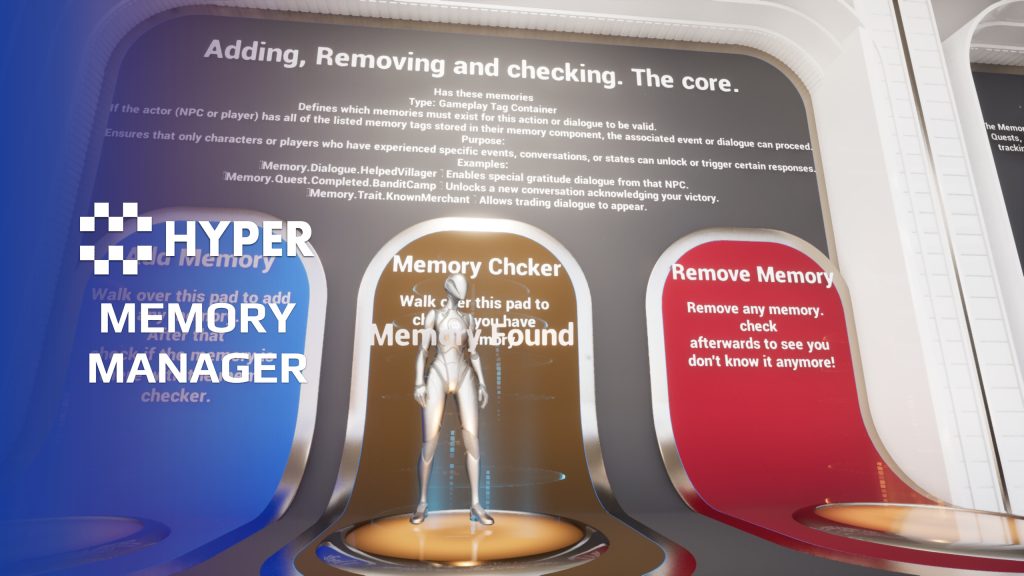
Let the game remember a promise, discovery or past encounter. Hyper Memory Manager stores Gameplay Tag facts on actors so dialogue, quests, map markers and world logic can respond to what happened earlier.
Key Features
Record and check facts
- Add and remove memories: update remembered state through gameplay events.
- Single or grouped queries: check one tag or a collection of required memories.
- Memory context: require certain facts while blocking a result when conflicting memories exist.
- Separate actor knowledge: let the player and each NPC keep their own record.
Connect game systems
- Dialogue conditions: change available lines or choices according to remembered actions.
- Quest outcomes: grant a memory when the player completes a relevant stage or event.
- Map markers: connect discoveries and story outcomes to marker data.
- Event bindings: record events such as an NPC being hit by the player.
- Area triggers: add or remove contextual facts when entering or leaving a place.
The component provides a small Blueprint interface for tag-based state. Add the memory where the event occurs, then query that same fact wherever the game should react to it.
32 reviews for Memory Manager
You must be logged in to post a review.
Frequently asked questions
Why Hyper?
The strongest public modular Unreal Engine framework available at this scale
Most studios keep tools like this internal. Hyper makes a serious technical foundation available to solo developers, indies, and teams.
Built from 75,000+ hours of Unreal Engine work
System design, Blueprint architecture, multiplayer patterns, documentation, testing, integration, iteration, and real production problem-solving.
Systems designed to work together
Inventory, crafting, equipment, interaction, UI, combat, attributes, multiplayer, AI, quests, dialogue, maps, progression, survival systems, environment tools, performance helpers, and more can all live inside one larger ecosystem.
Working systems with source
Hyper gives you functional systems, a modular structure and documentation, with source you can extend for your own game.
Architecture you can extend
Hyper is built around scalable architecture: gameplay tags, structured data, child Blueprints, clean overrides, reusable components, and clear project boundaries.
Start fast, grow cleanly
Build on the included systems, replace visuals, adjust data, create child Blueprints and connect features without rebuilding the same foundation from scratch.
Want to learn more about the Hyper ecosystem, architecture philosophy, workflows, and developer behind it? Read more here and get started (https://gamesbyhyper.com/docs/getting-started/start-here/).
How do I add this to my project?
This module is provided as a full project because it includes Gameplay Tags, collision settings, config settings and other project-level dependencies.
Use our free Integration Tool (https://gamesbyhyper.com/product/integration-tool/) to prepare the integration. It combines compatible Hyper projects and handles migration and the required project settings. Use matching Unreal Engine versions and compatible Hyper releases.
Your own character, GameMode or custom systems may still need to be connected. The Integration Tool walkthrough (https://gamesbyhyper.com/docs/getting-started/use-the-automatic-integration-tool/) explains the setup and what to check in the generated project.
Do I need to use other Hyper systems with this?
No. You can use your own systems.
Hyper modules are designed around interfaces, abstract classes, shared contracts and dynamic dispatch, so features are not tied to one specific implementation.
If a module demonstrates integration with our Inventory, Equipment, Interaction, Movement, NPC or another Hyper system, you can:
Use the included Hyper implementation.
Replace it with your own system.
Use our implementation as a reference for your own integration.
The supplied integration shows how the module connects to the rest of a game. You can connect your own implementation through the same interface, abstract class or integration point.
For example, Attribute Manager may demonstrate Equipment modifying attributes. That does not mean you must purchase our Equipment System. You can follow the same integration pattern with your own equipment system.
The module includes working gameplay and its integration points. Build on the supplied setup or connect your own systems where you want different behavior.
See how to adapt a module (https://gamesbyhyper.com/docs/getting-started/customize-modules/) and how the shared data and abstract classes work (https://gamesbyhyper.com/docs/project-foundations/datamanagement/).
Where should I put my own changes?
Keep your own Blueprints, UI and data in your project's folder, for example Content/MyProject. Use child Blueprints or replacement components for your custom logic where possible.
That keeps your changes separate when you update Hyper. If you edit the original framework files directly, you will need to merge those edits when updating. The folder structure guide (https://gamesbyhyper.com/docs/project-foundations/folder-structure/) explains where everything belongs.
What does an actor remember?
Actors can remember facts, objects or locations, organize them with tags and forget entries over time.
Is this a complete NPC behavior system?
Memory Manager stores and retrieves the information. Your AI, dialogue or quest logic decides how to respond to those memories.
Compatibility and file information
- Development platforms
- Linux, Windows, macOS
- Tested platforms
- Windows
Versions and compatibility
| Version | Release | Unreal Engine |
|---|---|---|
| V4V4 UE5.7, 5.8. Release: V4. | V4 | 5.7, 5.8 |
Implementation and interaction
- Modular / extensible
- Yes
- Multiplayer ready
- Yes
- UI components
- Yes
- Input methods
- Gamepad, Keyboard, Mouse
- AI gameplay features
- No
System setup
- Component: AC_Memory attached to the actor that owns the knowledge.
- Data: Gameplay Tag memories and has/cannot-have context checks.
- API: add, remove and query individual or grouped memories; match a memory context.
- Integration: event listeners, dialogue requirements, quest rewards and map-marker configuration.
Compatibility
- Networking: replicated multiplayer support.
- Platform testing: Windows tested.
- Plugins: Common UI.
Release notes | Documentation | YouTube | Discord
Documentation, videos and Discord are public. Verified buyers can use the support forums.

deepIndustries –
Review from FabAfter examining the plugin, I could not find the advertised “Memory Fading” feature, which makes the product page feel misleading. The documentation link is also frustrating, as it directs users to the developer’s general documentation landing page rather than the documentation for this specific asset. Additionally, the included demo level is extremely bare-bones and does little to demonstrate how the plugin could be used in practical or meaningful scenarios. Overall, the asset gives the impression that it was released in a rushed and incomplete state.
Dalcon4 –
Review from FabThe Hyper Memory System v4 gives every actor in your game world a personalized memory record. Each actor with a Memory Component maintains its own history of events, interactions, and knowledge that can be dynamically added, removed, and queried at runtime. This enables sophisticated gameplay mechanics where dialogue, AI behavior, and world logic evolve based on what characters have experienced. The system is impressively deep. It supports typed memory entries, timestamp tracking, memory decay over time, priority-based recall, cross-actor memory sharing, and conditional queries that can filter memories by type, age, or relevance. The data model is flexible enough to represent anything from simple boolean flags to complex multi-parameter event records.
NotTheFed –
Review from FabI have a LOT of Hyper’s kits.. and for a lot it is plug in play for the basics. I have MST PRO as the base framework, and just plug in those that are relevant for my game like Dialog, companion, advanced NPC, lockpicking, Skills, quests, traps, unlock (learn), world map, weathertime, Skinning, body decompose, Mesh to Actor swap, Admin console, with chat.. and so on. Simple to understand, and gets you started with most key parts of any game framework I highly recommend, not just for the quality of the kit.. but the excellent support on discord. The very detailed documentation.