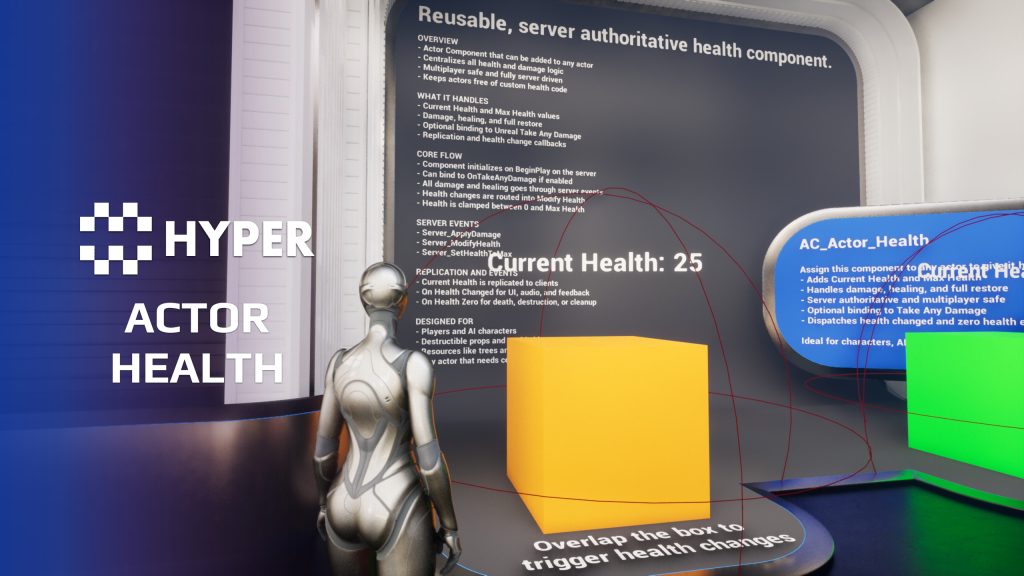
Description
Documentation | Discord | Videos | Demo
Hyper Actor Health System v4
Need the same health rules for a character, a destructible prop and a harvestable object? Hyper Actor Health System gives actors a reusable component for damage, healing and health changes, with replicated state for multiplayer.
Configure the actor's current and maximum health, then let the component handle health changes through one consistent path. Your actor decides what happens when its health changes or reaches zero, whether that means updating a health bar, playing an effect, dropping resources or starting a death sequence.
Key Features
Health, damage and healing
- Reusable actor component: add health to characters, AI, props, vehicles or other actors without rebuilding the same logic in each Blueprint.
- One modification path: apply damage, restore health or return an actor to full health through the same health-handling logic.
- Defined limits: clamp health between zero and the configured maximum, keeping damage and healing within the actor's health range.
Gameplay reactions and multiplayer
- Health-change events: receive the new health value and changed amount for UI, sound, visual effects and other gameplay responses.
- Zero-health callback: connect your own death, destruction, cleanup or state-change behavior when health reaches zero.
- Built-in damage binding: optionally connect to Unreal's Take Any Damage event, or use the component's server events for a custom damage workflow.
- Server-authoritative updates: process health changes on the server and replicate current health to connected players.
From a hit to a gameplay response
A breakable object can lose health when hit and use the zero-health event to spawn debris or release a reward. A character can use the same component to update its health display after damage or healing. These responses stay in your gameplay code, while the component owns the health values and their limits.
Actor integration and feedback
- Actor setup: the supplied actor has the health component connected, so you can inspect and adapt its implementation.
- UI connection: use the health-change callback to drive a health bar or damage indicator, without placing presentation logic inside the health component.
Try it in your project
Open the demo to explore the health workflow, then follow the documentation to configure your first actor and connect its health events.
35 reviews for Actor Health System
You must be logged in to post a review.
Frequently asked questions
Why Hyper?
The strongest public modular Unreal Engine framework available at this scale
Most studios keep tools like this internal. Hyper makes a serious technical foundation available to solo developers, indies, and teams.
Built from 75,000+ hours of Unreal Engine work
System design, Blueprint architecture, multiplayer patterns, documentation, testing, integration, iteration, and real production problem-solving.
Systems designed to work together
Inventory, crafting, equipment, interaction, UI, combat, attributes, multiplayer, AI, quests, dialogue, maps, progression, survival systems, environment tools, performance helpers, and more can all live inside one larger ecosystem.
Working systems with source
Hyper gives you functional systems, a modular structure and documentation, with source you can extend for your own game.
Architecture you can extend
Hyper is built around scalable architecture: gameplay tags, structured data, child Blueprints, clean overrides, reusable components, and clear project boundaries.
Start fast, grow cleanly
Build on the included systems, replace visuals, adjust data, create child Blueprints and connect features without rebuilding the same foundation from scratch.
Want to learn more about the Hyper ecosystem, architecture philosophy, workflows, and developer behind it? Read more here and get started (https://gamesbyhyper.com/docs/getting-started/start-here/).
How do I add this to my project?
This module is provided as a full project because it includes Gameplay Tags, collision settings, config settings and other project-level dependencies.
Use our free Integration Tool (https://gamesbyhyper.com/product/integration-tool/) to prepare the integration. It combines compatible Hyper projects and handles migration and the required project settings. Use matching Unreal Engine versions and compatible Hyper releases.
Your own character, GameMode or custom systems may still need to be connected. The Integration Tool walkthrough (https://gamesbyhyper.com/docs/getting-started/use-the-automatic-integration-tool/) explains the setup and what to check in the generated project.
Do I need to use other Hyper systems with this?
No. You can use your own systems.
Hyper modules are designed around interfaces, abstract classes, shared contracts and dynamic dispatch, so features are not tied to one specific implementation.
If a module demonstrates integration with our Inventory, Equipment, Interaction, Movement, NPC or another Hyper system, you can:
Use the included Hyper implementation.
Replace it with your own system.
Use our implementation as a reference for your own integration.
The supplied integration shows how the module connects to the rest of a game. You can connect your own implementation through the same interface, abstract class or integration point.
For example, Attribute Manager may demonstrate Equipment modifying attributes. That does not mean you must purchase our Equipment System. You can follow the same integration pattern with your own equipment system.
The module includes working gameplay and its integration points. Build on the supplied setup or connect your own systems where you want different behavior.
See how to adapt a module (https://gamesbyhyper.com/docs/getting-started/customize-modules/) and how the shared data and abstract classes work (https://gamesbyhyper.com/docs/project-foundations/datamanagement/).
Where should I put my own changes?
Keep your own Blueprints, UI and data in your project's folder, for example Content/MyProject. Use child Blueprints or replacement components for your custom logic where possible.
That keeps your changes separate when you update Hyper. If you edit the original framework files directly, you will need to merge those edits when updating. The folder structure guide (https://gamesbyhyper.com/docs/project-foundations/folder-structure/) explains where everything belongs.
Can I use this on objects other than player characters?
Yes. Add the health component to the actor you want to manage. You can use it for players, NPCs, destructible props and vehicles.
Can I connect health changes to my own UI?
Yes. Use the health and death events to update your own health bar or trigger other gameplay logic.
Compatibility and file information
- Development platforms
- Linux, Windows, macOS
- Tested platforms
- Windows
Versions and compatibility
| Version | Release | Unreal Engine |
|---|---|---|
| V4V4 UE5.7, 5.8. Release: V4. | V4 | 5.7, 5.8 |
Implementation and interaction
- Modular / extensible
- Yes
- Multiplayer ready
- Yes
- UI components
- Yes
- Input methods
- Gamepad, Keyboard, Mouse
- AI gameplay features
- No
System setup
- Architecture: AC_Actor_Health is a reusable Actor Component with server events and replicated Current Health.
- Configuration: Current Health, Max Health and optional binding to the owning actor's Take Any Damage event. Health state lives on the component; no DataTables are required.
- Health operations: damage, signed health modification and full restore share the clamped Modify Health path.
- Extension points: On Health Changed provides the new value and delta. On Health Zero lets the owning actor define its reaction.
Compatibility
- Networking: replicated multiplayer support.
- Platform testing: Windows tested.
- Plugins: Common UI.
Release notes | Documentation | YouTube | Discord
Documentation, videos and Discord are public. Verified buyers can use the support forums.

Dalcon4 –
Review from FabThe Hyper Actor Health v4 (part of the Attribute Manager framework) is a robust, multiplayer-ready health and attribute management system. It handles health, shields, damage processing, death states, and regeneration with full replication support. Built to work seamlessly with the Combat Framework, it is the essential vitality layer for any actor in your game world. The health system goes far beyond a simple float value. It supports multiple health pools (health, shields, armor), damage type filtering, resistance calculations, invulnerability frames, regeneration with configurable rates and delays, death and revival states, and damage event broadcasting. Every aspect of how actors take, resist, and recover from damage is configurable. Implementation is straightforward. Add the Health Component to any actor, set your max health and default parameters, and the system handles damage processing, death detection, and state management automatically. The component exposes clear events for health changes, damage taken, death, and revival that are easy to bind to UI, VFX, and gameplay logic.
NotTheFed –
Review from FabI have a LOT of Hyper’s kits.. and for a lot it is plug in play for the basics. I have MST PRO as the base framework, and just plug in those that are relevant for my game like Dialog, companion, advanced NPC, lockpicking, Skills, quests, traps, unlock (learn), world map, weathertime, Skinning, body decompose, Mesh to Actor swap, Admin console, with chat.. and so on. Simple to understand, and gets you started with most key parts of any game framework I highly recommend, not just for the quality of the kit.. but the excellent support on discord. The very detailed documentation.